Forgiveness Is Not an Escape from Guilt: What the Beta Israel Tradition Teaches About Atonement
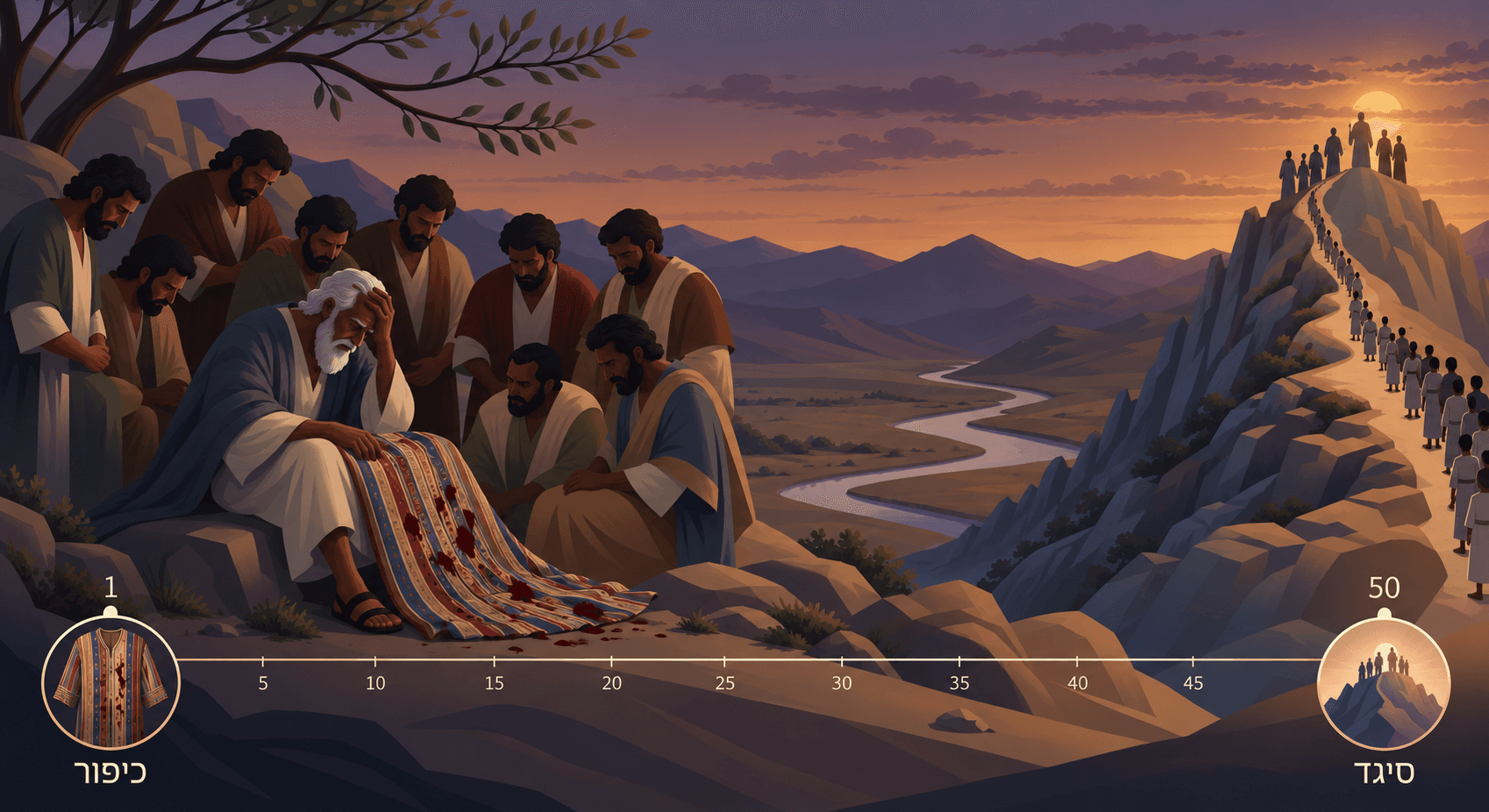
What hidden thread connects a bloodstained coat, a day on which fasting and joy exist side by side, and the holiday of Sigd, which arrives fifty days later? In the Beta Israel tradition, these moments form a single continuum of sin, atonement, and covenant renewal. From Jacob’s grief emerges a demanding conception of forgiveness: the past remains present, the person who was harmed is not required to forget, and the real test begins precisely after forgiveness has been asked
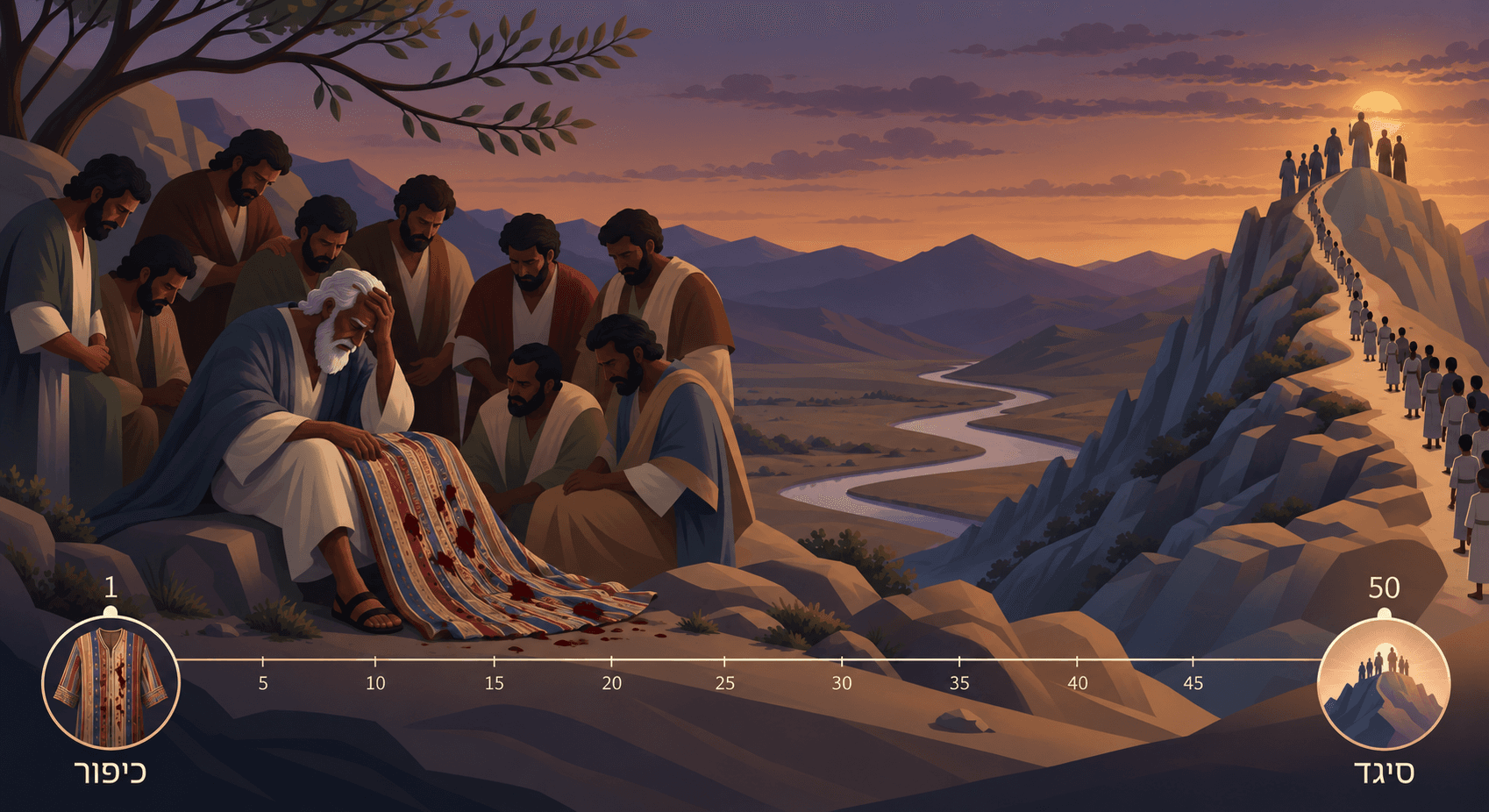
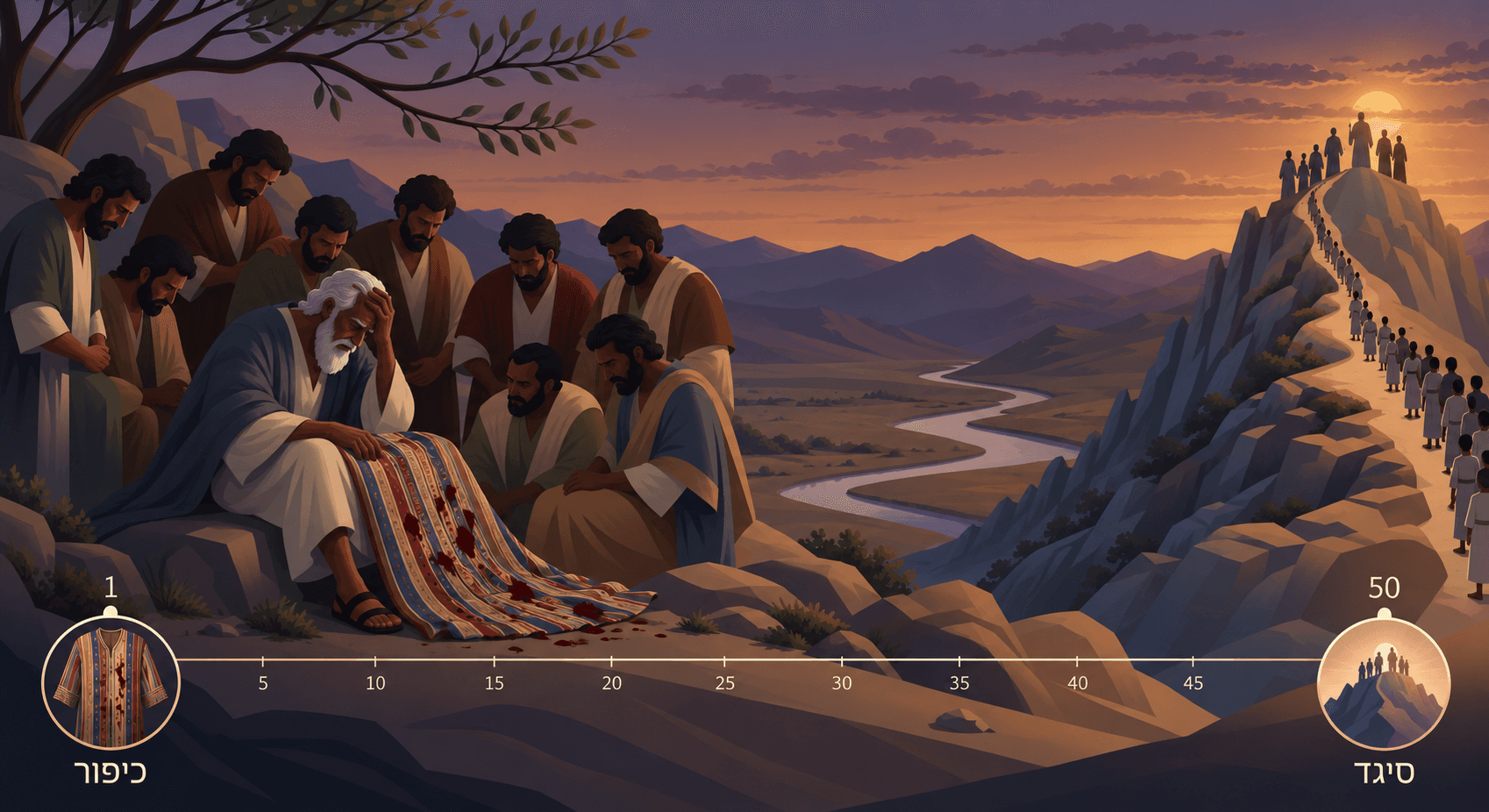
The coat reached Jacob without Joseph. His brothers slaughtered a young male goat, dipped the garment in its blood, and sent it home. When it was placed before Jacob, they said only: “We found this. Please identify whether it is your son’s coat or not.” He recognized it immediately and said in anguish: “It is my son’s coat. A wild animal has devoured him. Joseph has surely been torn to pieces.” None of them said that Joseph was dead. The evidence was placed before him, and he completed the story himself. Thus began mourning for a death that had never occurred. Joseph was still alive while his father tore his clothes, put on sackcloth, and refused to be comforted. The lie was created in a moment, but its cost endured for years.
The act of selling Joseph was directed at him, but the rupture spread far beyond his personal fate. Joseph was thrown into a pit, sold, taken down to Egypt, made a slave in the house of Potiphar, captain of Pharaoh’s guard, imprisoned, and eventually rose to prominence. In his father’s home, life froze and a parallel reality took shape. Jacob lived for many years beneath a thick cloud of bereavement. His sons continued to walk beside him while carrying the poisonous knowledge that the grief organizing the family’s life rested on a lie. Each bore a different consequence of the same act: Joseph carried the scar of betrayal, Jacob the false bereavement, and the brothers the burden of guilt for the reality they had created with their own hands. One injury had thus fractured into many lives.
One of the central Yom Kippur traditions of Beta Israel Judaism returns us to precisely this place. In an article published in 2024, Rabbi Dr. Sharon Shalom documents two names given to the sacred day in the community’s tradition: “Asterai,” translated as the “Festival of Seeing,” and “Ba’al Yosef,” the Festival of Joseph. Shalom points to the Book of Jubilees, which connects the tenth day of the seventh month with the bitter news about Joseph that brought Jacob into mourning, and describes it as a date established for generations for atonement and purification for the sin and for the sorrow his sons caused their father. Alongside the written source, an oral tradition was preserved that associates the same date with the reunion of Jacob and Joseph after years of separation. The two traditions illuminate different aspects of the same day: one returns to the moment of rupture, the other to the possibility of meeting again after it.
The name “Asterai” also carries more than one meaning. In his article, Shalom refers to the explanation offered by tradition scholar Yossi Ziv, who connects the idea of “seeing” with the bloodstained coat presented to Jacob. Shalom adds that Ziv cites the testimony of Kes Amha Negat, according to whom the name is also associated with the second Tablets of the Covenant, which were brought down on Yom Kippur. The two traditions give the day different layers of meaning: one concerns the brothers’ sin and the need for atonement, the other revelation and covenant renewal. Yom Kippur in the Beta Israel tradition thus moves between the memory of injury and the possibility of rebuilding a relationship.
The story of Joseph therefore raises a difficult question about the nature of forgiveness. The biblical ending is far removed from a simple restoration of the world to what it was before. Jacob lost years of his life to mourning, Joseph became a different person because of the pit, slavery, and prison, and the brothers continued to carry their deed even after the family was reunited. The reunion creates the possibility of a different life, but it takes place within a reality that has already changed. Reconciliation opens a future; it does not restore the past.
Forgiveness That Leaves Room for Memory
When Joseph reveals his identity to his brothers in Egypt, he begins with the very fact they may have hoped to bury: “I am Joseph, your brother, whom you sold into Egypt.” Blood kinship and betrayal are bound together in the same sentence. Rather than bypassing the act on the way to reconciliation, Joseph places it at the heart of the encounter. Only after the injury has been called by its name can a new space open in the relationship between the brothers.
From Jacob’s perspective, the news that Joseph is still alive fundamentally changes the present, but the years that have passed remain part of his life story. A person can mourn something that never occurred in reality and still pay a very real price for it. The tears that were shed, the years that were consumed, and the relationships shaped around bereavement do not disappear when the truth is revealed. Here the story of Joseph touches a deep human nerve: a new truth can change the direction of life from this point forward, but the price already paid remains part of the person who carries it.
Rabbinic tradition and the Beta Israel tradition meet at this point more closely than might appear. The Mishnah in tractate Yoma states that transgressions between one person and another are atoned for only after the offender “appeases his fellow.” The sanctity of the day alone does not bypass the person who was harmed. The prophet Isaiah, whose words are read on the morning of Yom Kippur, likewise condemns a fast detached from moral action and demands the sharing of bread with the hungry and the loosening of the bonds of oppression. In both sources, the value of religious ritual is tested by what it produces beyond its own boundaries.
This also sharpens the limits of a request for forgiveness. A person can acknowledge a sin, suffer remorse, and change his ways, but the process undergone by the offender does not give him ownership over the response of the person who was harmed. Forgiveness is not a right that becomes due on a fixed date, and the injured person is not obligated to reopen a damaged relationship simply because the other party has changed. Sometimes relationships are rebuilt, sometimes they remain cautious and scarred, and sometimes the separation remains in place. The offender’s responsibility lies in what he repairs and in the way he changes; the nature of the relationship from that point forward is also determined by the person on the other side.
The Individual, Guilt, and Public Responsibility
Here the Beta Israel tradition offers another perspective. Shalom distinguishes between a paradigm in rabbinic tradition that gives substantial weight to the idea of teshuvah, repentance or return, and a paradigm in the Beta Israel tradition in which kapparah, atonement, stands at the center. In his interpretation of the community’s religious world, the individual experiences himself as part of a collective body standing together before God. The distinction is not absolute: rabbinic tradition itself is rich in communal prayer and mutual responsibility, and Beta Israel also preserves the place of the individual. The difference lies in the center of gravity and in the way religious responsibility is experienced.
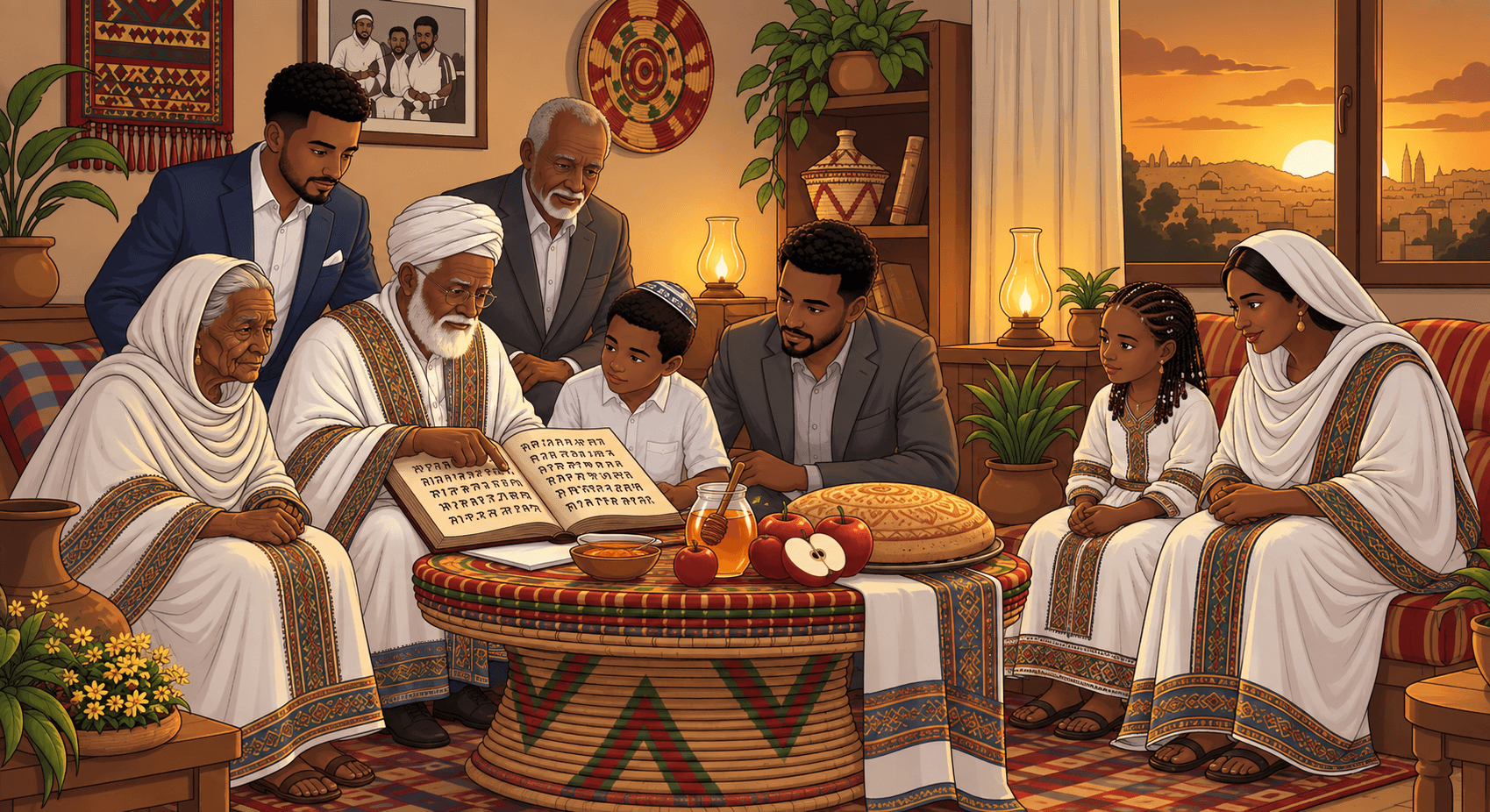
This is especially evident in descriptions of Yom Kippur in Ethiopia. Shalom cites Jacob Faitlovitch’s account of his 1904 visit, in which emotionally charged prayers appear alongside singing and dancing during the day. He also recounts testimonies from members of the community about an occasion they awaited with joy, and about the contrast experienced by many Ethiopian Jews who had grown up in Jewish villages when they arrived in Ashkenazi yeshiva settings in Israel and encountered the atmosphere of the “Days of Awe.” Fasting and heartfelt supplication existed alongside joy, which arose from faith in atonement and in God’s mercy.
To contemporary Israeli eyes, this combination may at first appear paradoxical. Many are accustomed to associating confession of sin with gravity, awe, and solitude before the seat of judgment. In the words of the Ethiopian sage Daniel Mengesha, as cited by Shalom, a person stands before God as part of a community. The sorrow of failure, the hunger of the fast, and the pulse of joy can therefore exist within the same space. Responsibility remains complete, and alongside it exists faith in the possibility of returning and rebuilding.
This understanding has significance that extends beyond the religious occasion. Responsibility for an act rests on the shoulders of the person who committed it, and the community cannot serve as a refuge for guilt. Yet the consequences of harm sometimes extend beyond the boundaries of the person who caused it. One person causes harm, and an entire family continues to live with the wound. A manager leaves a position, but the culture that manager created continues to shape the institution. A decision made by one generation determines the starting point of the next. The question “Who is to blame?” therefore does not fully overlap with the question “Who is able to repair?”
Here lies the boundary between a community that demands forgiveness from the injured person in order to restore quiet, and a community that takes responsibility for creating the conditions that will make repair possible. The first places an additional obligation on the person who was harmed. The second examines which patterns, institutions, and habits must change so that the harm does not reproduce itself. A collective consciousness thus broadens the concept of atonement: individual responsibility remains intact, but it is joined by shared responsibility for the reality that will be built from this point forward.
The Fifty Days in Which Atonement Moves Into Life
The connection between Yom Kippur and the holiday of Sigd adds a dimension of time to this understanding. Sigd, observed on the 29th of Heshvan, fifty days after Yom Kippur, centers on the renewal of the covenant among the people, God, and the Torah, alongside fasting, supplication, and longing for Zion. The Knesset lexicon describes it as a form of communal self examination that supplements that of Yom Kippur, and notes that according to tradition, the sins of community members are atoned for and forgiven on Yom Kippur and during the fifty days of repentance that follow it. On the fiftieth day, the community returns to the experience of Yom Kippur through prayer and fasting. The work of the soul thus acquires duration, rather than existing only as a single climactic moment.
At the same time, it is important to avoid imposing contemporary psychological terminology on a tradition that spoke in a different language. The sources speak of atonement, communal self examination, and covenant. The fifty days can be read as a space in which one asks whether the recognition of sin crosses the boundaries of prayer and enters life itself. A sacred day can gather into itself intention, awe, hope, and remorse; change is revealed in the routine that begins afterward.
Renewing a covenant is different from asking for forgiveness. A request for forgiveness addresses the rupture that has already occurred; the covenant defines the relationship people seek to sustain from this point onward. Placing the two observances along the same continuum gives forgiveness a dimension of time and action. The decisive question shifts from the moment in which the word “sorry” is spoken to what will happen when the same conditions that produced the original harm return.
That is usually where the difficult test lies. A person may understand at night the depth of the harm caused to someone close, and in the morning encounter the same patterns that led to it. An institution can publish a precise and polished apology while continuing to operate through the same mechanism that created the injustice. A public can bow its head on one day and immediately afterward return to a routine of indifference. The time after recognition is therefore part of the repair itself. That is where it becomes clear whether words have become behavior.
In this context, Sigd takes on a meaning broader than that of another event added to the holiday calendar. Covenant renewal places beside remorse a demand to rebuild relationship, commitment, and a way of life. It does not compel the restoration of what has been lost, but it can change the conditions within which people continue to live together. In this way, forgiveness moves from the emotional moment to the place where decisions take shape in life.
What Happens When Heritage Speaks Again
Placing the Book of Jubilees at the heart of the connection between the story of Joseph and Yom Kippur adds a historical and cultural dimension to the discussion. Entire realms of Beta Israel’s religious world were preserved for generations within a Jewish tradition that developed far from the rabbinic centers that shaped most Jewish communities. When this tradition enters Israeli discourse today, it brings with it more than another custom on the holiday calendar. It offers a way to read familiar concepts anew. Yom Kippur remains a day of fasting and repentance, but Jacob’s fractured family enters the picture of atonement and restores to it the human cost of harm.
This process takes on greater importance at a time when the community’s sacred texts are undergoing documentation and efforts to make them accessible. The National Library of Israel, the Ethiopian Jewry Heritage Center, and Tel Aviv University’s “Tofsei HaOrit” program are working to digitize Beta Israel sacred books and manuscripts. The work of preservation is important in itself, but its value extends beyond the number of pages that will be scanned or the quality of the archive that will be created. A living heritage is also measured by its ability to remain active within life: in practices, religious ways of life, language, values, and the ways in which people understand themselves and their world.
Preservation is therefore a starting point, not a final destination. A tradition also needs a way to be heard, studied, and transmitted between generations. A manuscript can be physically saved and still drift away from the life of society. When a text, practice, or tradition returns to public discourse, it moves from documentary material to a source of thought, identity, and interpretation. The phrase “living books,” used by the National Library of Israel, acquires its full meaning only when life continues beyond the doors of the archive.
The Book of Jubilees illustrates this well. Its place in Beta Israel’s religious world makes it possible to read the connection between the story of Joseph and Yom Kippur through a Jewish tradition preserved within the community for generations. This reading shifts the focus of the question away from the way a person asks forgiveness and toward the person who was harmed, the community in which the injury occurred, and the relationships that will need to be rebuilt. A heritage preserved across generations thus assumes an active role in the Israeli conversation about atonement.
There is also a change here in the way Beta Israel heritage itself can be understood. For many years, discussion of the heritage of minority communities focused on the fear of disappearance and on the need to rescue, collect, and document. Preservation is essential, but the vitality of a heritage is tested at the next stage: when the knowledge that has been preserved enters living culture and influences language, education, thought, and the way a society interprets itself.
All of this returns us to the distance between the bloodstained coat and the family that meets again after years of separation. The Beta Israel tradition does not offer a simple solution to the question of forgiveness, nor does it promise that every wound will end in reconciliation. It places side by side sin and atonement, pain and joy, individual responsibility and collective consciousness, one sacred day and fifty days in which the path from that day back into life is tested.
Tomorrow evening, September 20, 2026, Yom Kippur 5787 will begin. Many will stand in synagogues and pour out their hearts. Others will fast in keeping with the tradition of their family. Some will ask forgiveness face to face, while others will pass through the day without marking it in religious terms. Beyond these differences, one question remains: What act from the past year continues to operate in another person’s life, and what has changed in us in light of that knowledge?
And then the coat returns. The blood absorbed into it was meant to convince Jacob that the greatest disaster of all had occurred, and it succeeded. When he learned years later that Joseph was alive, that knowledge changed the future but did not erase the mourning the father had already endured. Joseph did not get his youth back, and the brothers could not remove from the family’s history the pit into which they had thrown him. And yet, out of the rupture came the possibility of a different relationship, because the past could no longer be changed, but the path from this point forward remained open to choice.
This may be Beta Israel’s deepest contribution to the conversation about forgiveness. It does not demand a choice between past and future, nor does it promise that every injury can be repaired. The demand is more difficult: to acknowledge what happened, to take responsibility for what can still be repaired, and to test forgiveness in the world built after it has been spoken. Forgiveness, then, does not erase the stain; it determines whether the stain will become an inheritance.